
Mitigating Structural Risks in Microcement Applications
A crucial technical protocol covering underfloor heating, concrete moisture limits, and kinetic energy control joints to prevent structural failure in seamless microcement finishes.
Microcement is an exceptionally durable thin-coat polymer-modified cementitious system, but its performance depends almost entirely on the stability of the underlying substrate. Because microcement is bonded directly to concrete screeds, self-leveling compounds, or subfloors, any structural movement, residual moisture vapor, or thermal expansion in the base layer will inevitably transfer to the surface layer. Mitigating structural risks before priming and application is essential for a long-lasting, crack-free installation.
The Three Critical Structural Risk Categories
Before applying microcement, applicators and site engineers must strictly adhere to specific protocols for thermal stress, moisture content, and structural settlement joints:
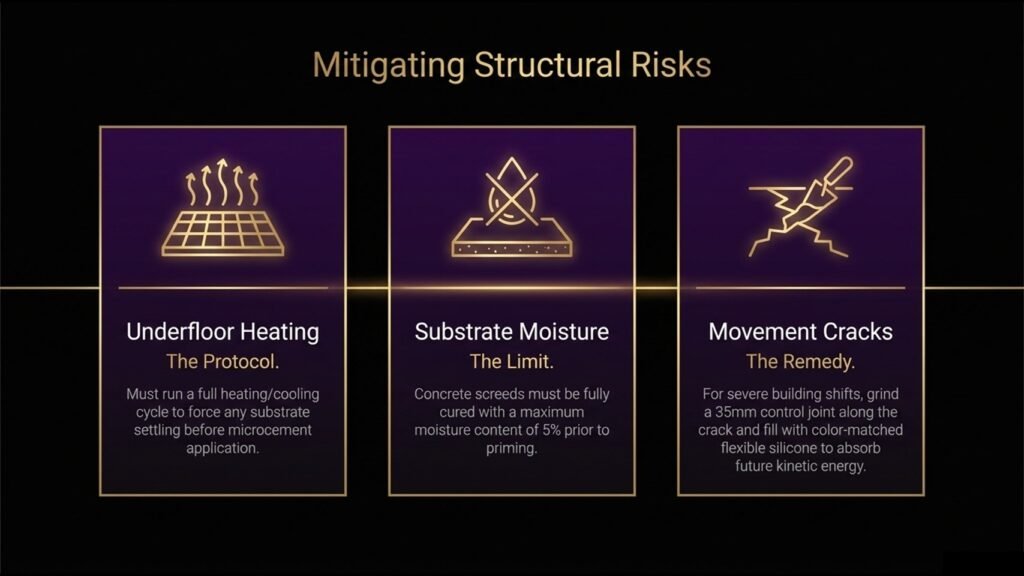
Underfloor Heating
The Protocol.Must run a full heating/cooling cycle to force any substrate settling before microcement application.
Substrate Moisture
The Limit.Concrete screeds must be fully cured with a maximum moisture content of 5% prior to priming.
Movement Cracks
The Remedy.For severe building shifts, grind a 35mm control joint along the crack and fill with color-matched flexible silicone to absorb future kinetic energy.
Underfloor Heating: Thermal Commissioning Protocol
Installing microcement over hydronic or electric radiant underfloor heating systems requires a strict thermal shock commissioning protocol. Subfloors undergo thermal expansion and contraction when heated. If microcement is applied before this movement occurs, microscopic shear stresses will cause surface delamination or hairline fracturing.
The Protocol: The heating system must be gradually brought up to operational temperature, held for several days, and gradually cooled back down to ambient room conditions. Running this full heating/cooling cycle forces any inherent substrate settling and residual tension release prior to priming and microcement layering.
Substrate Moisture: The 5% Critical Curing Limit
Trapped moisture is one of the leading causes of coating blisters, pinholes, and adhesion failure. Standard concrete screeds release vapor continually as they cure. Applying microcement primers or base coats over high-moisture concrete traps water vapor, leading to hydrostatic pressure buildup beneath the seamless layer.
The Limit: Concrete screeds and subfloors must be fully cured and tested with a professional moisture meter. The maximum allowable substrate moisture content is strictly 5% prior to priming. If moisture levels exceed 5%, vapor barrier epoxy primers or prolonged curing times must be enforced.
Movement Cracks: 35mm Control Joints & Kinetic Absorbers
Structural settlement and building shifts naturally produce tension fractures along weak points in screeds and slabs. Attempting to bridge active structural cracks with rigid microcement will only result in reflective cracking on the surface.
The Remedy: Where severe building shifts or active cracks exist, installers must grind a dedicated 35mm control joint directly along the crack path. This joint is cleaned, primed, and filled with a high-grade, color-matched flexible silicone or polyurethane sealant. This elastic buffer acts as a kinetic energy absorber, allowing independent building movement without damaging the surrounding continuous microcement floor.
Technical Engineering Takeaway
Achieving a flawless microcement finish requires rigorous substrate preparation. By verifying a maximum 5% substrate moisture threshold, completing thermal cycle protocols on underfloor heating, and engineering 35mm flexible control joints for building movement, site managers can guarantee long-term structural integrity and seamless aesthetics.