
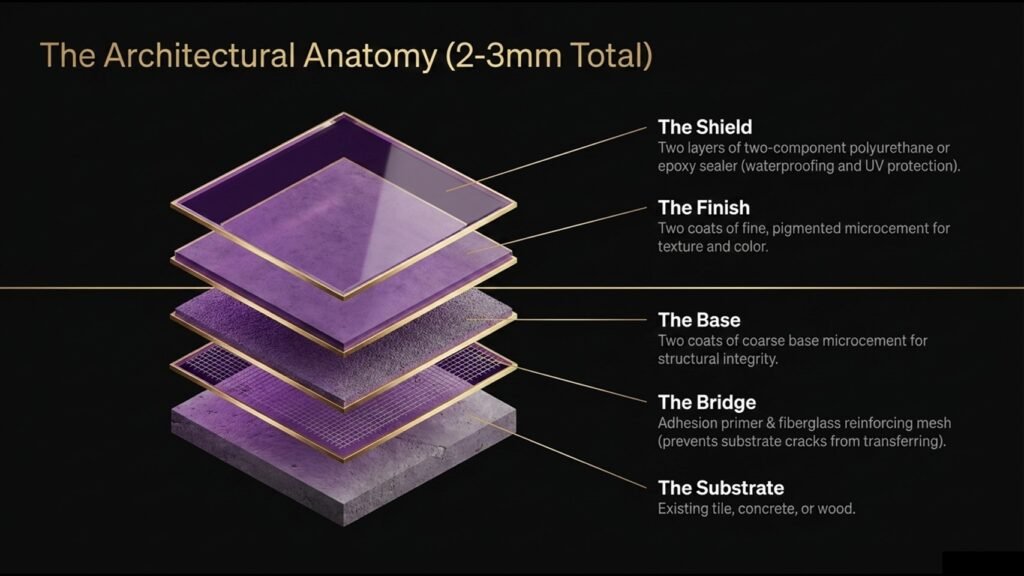
The Architectural Anatomy
Deconstructing the 5-layer engineering stack that delivers high strength, flexibility, and waterproofing within a total thickness of just 2 to 3 millimeters.
Achieving a seamless, durable surface without heavy demolition relies on advanced polymer chemistry and precise layer stratification. Although a complete microcement coating measures only 2 to 3 millimeters total, it consists of five distinct engineered layers designed to bind, flex, color, and seal.
The 5-Layer Structural Breakdown
Each layer in the microcement stack fulfills a specific mechanical or protective role in ensuring long-term surface stability:
1. The Shield
Top ProtectionTwo layers of two-component polyurethane or epoxy sealer. Provides complete waterproofing, stain resistance, chemical barrier protection, and high UV resistance against yellowing or fading.
2. The Finish
Aesthetic SurfaceTwo coats of fine, pigmented microcement. Formulated with ultra-fine mineral pigments and fine aggregate to create custom tactile textures, movement, and rich organic color tones.
3. The Base
Structural IntegrityTwo coats of coarse base microcement. Formulated with larger quartz sand particles to provide compressional strength, level subtle surface imperfections, and establish overall structural rigidity.
4. The Bridge
Crack MitigationAdhesion primer & fiberglass reinforcing mesh. Acts as an anti-fracture membrane, bridging minor substrate movements and preventing underlying tile joints or concrete cracks from transferring up.
5. The Substrate
Existing FoundationExisting tile, concrete, or wood. The original solid surface serves as the load-bearing foundation, eliminating the need for tear-out and heavy demolition waste.
Crack Mitigation & Mesh Reinforcement
The crucial connection point of the system is The Bridge. By embedding high-tensile fiberglass reinforcing mesh into a specialized adhesion primer, the microcement system gains multi-directional tensile flexibility. This absorbs micro-movements caused by structural settling or thermal changes, preventing surface reflection cracking.
The Shield: UV Protection & Waterproofing
While the internal microcement layers provide physical strength and aesthetic depth, The Shield guarantees longevity. Utilizing advanced two-component (2K) polyurethane or epoxy formulations creates an impermeable moisture barrier suitable for high-humidity environments, wet rooms, and sunlit exterior surfaces.
Architectural Takeaway
The architectural anatomy of microcement proves that extreme thickness is not required for high strength. By combining substrate adhesion, fiberglass mesh bridging, dual base structural layering, pigmented finishing, and 2K polyurethane sealing, microcement creates a waterproof, crack-resistant, 2-3mm continuous finish engineered to last.