
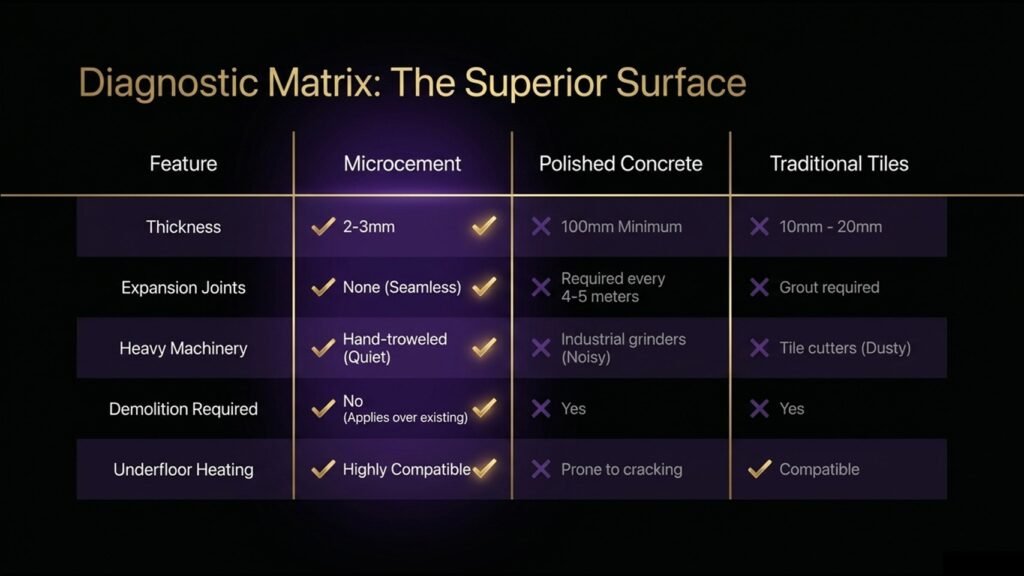
Diagnostic Matrix: The Superior Surface
A side-by-side engineering breakdown evaluating Microcement, Polished Concrete, and Traditional Tiles across thickness, joints, noise, demolition, and thermal compatibility.
Selecting the optimal surface finish for residential or commercial architectural projects requires balancing structural loads, installation conditions, aesthetic continuity, and thermal performance. The following diagnostic matrix details how microcement compares against traditional flooring solutions.
Comprehensive Diagnostic Matrix Table
This comparative diagnostic matrix evaluates key operational and physical performance metrics for Microcement, Polished Concrete, and Traditional Tiles:
| Feature | Microcement | Polished Concrete | Traditional Tiles |
|---|---|---|---|
| Thickness | ✓ 2–3 mm | ✕ 100 mm Minimum | ✕ 10 mm – 20 mm |
| Expansion Joints | ✓ None (Seamless) | ✕ Required every 4–5 m | ✕ Grout required |
| Heavy Machinery | ✓ Hand-troweled (Quiet) | ✕ Industrial grinders (Noisy) | ✕ Tile cutters (Dusty) |
| Demolition Required | ✓ No (Applies over existing) | ✕ Yes | ✕ Yes |
| Underfloor Heating | ✓ Highly Compatible | ✕ Prone to cracking | ✓ Compatible |
Profile Thickness & Structural Load Considerations
At an ultra-thin application profile of just 2 to 3 millimeters, microcement delivers industrial-grade durability without modifying existing door thresholds or adding substantial dead loads to building slabs. In contrast, polished concrete demands a minimum thickness of 100 mm (10 cm), rendering it unfeasible for most interior refurbishments, while traditional tiles add 10 to 20 mm plus tile adhesive depth.
Continuous Seamless Design vs. Expansion Joints & Grout
Visual uninterrupted flow is essential in contemporary architecture. Microcement creates a completely continuous monolithic surface with no expansion joints required within standard interior footprints. Polished concrete requires saw-cut expansion joints every 4 to 5 meters to mitigate structural shrinkage, whereas traditional tile installations inevitably rely on grout lines that harbor dirt and moisture over time.
Zero Demolition Advantage
Microcement bonds directly to underlying substrates, eliminating the noise, dust, and structural downtime associated with tearing out old ceramic tiles or concrete slabs.
Hand-Troweled Artisanal Finish
Applied using hand-troweling techniques without heavy industrial power tools, keeping the installation quiet, clean, and flexible for active commercial sites.
Quiet Hand-Troweled Application vs. Heavy Grinding Noise
Polished concrete installations rely on heavy, high-decibel industrial grinding machinery and generate significant silica dust. Traditional tile installations require motorized tile cutters. Microcement is precision-applied using manual hand trowels, making it quiet, dust-controlled, and ideally suited for occupied residential homes or active retail environments.
Underfloor Heating Thermal Efficiency
Because microcement is ultra-thin (2–3 mm) and polymer-modified, it possesses exceptional thermal conductivity and flexibility. It rapidly transfers heat from hydronic or electric underfloor heating systems without expanding or cracking. Thick concrete slabs retain heat poorly upon initial start-up and are prone to thermal shock cracking, while traditional tiles perform well but add thermal resistance through thick adhesive beds.
Engineering Summary
The diagnostic matrix confirms microcement as the superior surface choice for modern architectural projects. By pairing a 2–3 mm thin profile with high flexibility, zero expansion joints, no demolition necessity, and seamless underfloor heating performance, microcement outperforms both polished concrete and traditional tiling across every critical parameter.