
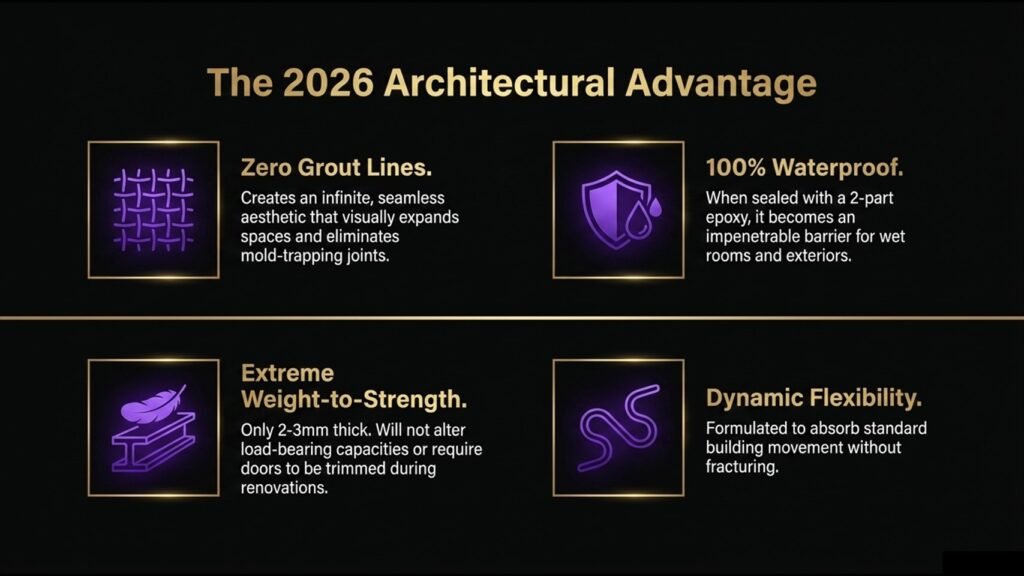
The 2026 Architectural Advantage
Four technical breakthroughs redefining modern surface design, durability, and seamless spatial engineering.
As modern architectural standards demand cleaner aesthetics and higher performance, traditional tile and stone coatings face increasing structural limitations. The modern microcement matrix addresses these core limitations through four distinct engineering advancements.
Zero Grout Lines.
Creates an infinite, seamless aesthetic that visually expands interior and exterior spaces while completely eliminating mold-trapping joints.
100% Waterproof.
When sealed with a specialized 2-part epoxy, it becomes an impenetrable barrier designed specifically for high-moisture wet rooms and demanding exterior environments.
Extreme Weight-to-Strength.
At only 2–3mm thick, it will not alter existing load-bearing capacities or require doors to be trimmed during interior renovation projects.
Dynamic Flexibility.
Formulated to absorb standard structural building movement, thermal expansion, and substrate vibration without fracturing or cracking.
Eliminating Maintenance and Structural Overhead
In high-end architectural designs, the transition from traditional tiled surfaces to continuous microcement coatings yields significant maintenance savings. Conventional grout lines deteriorate over time under moisture exposure, whereas a continuous 2-part epoxy sealed layer retains its integrity across wet rooms, swimming pool surrounds, and high-traffic commercial spaces.
Renovation Speed Without Demolition
By delivering exceptional tensile strength at a thickness of under 3mm, microcement allows architects to specify premium concrete aesthetics without incurring heavy demolition waste or altering critical structural clearances.
Architectural Takeaway
The combination of zero grout joints, total waterproofing, minimal weight overhead, and structural flex resistance positions modern microcement as one of the most efficient and adaptable surface technologies available in 2026.